-
Connect With Your Ottawa IT Service Company at (613) 828-1384

Connect With Your Ottawa IT Service Company at (613) 828-1384


A comprehensive security audit conducted by a Managed IT services provider is a strategic necessity that bridges the gap between operational defense and regulatory compliance. For corporate security managers, an external assessment provides objective visibility to identify vulnerabilities, mitigate internal risks, and validate defenses against frameworks like SOC 2, ISO 27001, and NIST. This article outlines the four critical phases of a professional network security audit, highlighting how assessors evaluate internal security concerns—from insider threats to shadow AI—and map those findings to strict compliance mandates. By understanding this methodology, security leaders can transform an audit from a routine checklist into a catalyst for a resilient, compliant enterprise.
Managing a corporate security posture requires balancing external defense with internal governance. As regulatory requirements tighten and internal ecosystems become more complex, defending the perimeter is no longer enough. You must actively prove your network’s resilience to auditors, board members, and clients.
Bringing in an external Managed IT services provider or a specialized cybersecurity firm shifts your posture from reactive to proactive. An external audit provides an unbiased, adversarial perspective on your network while ensuring your operational realities match your written policies.
Here is what to expect when professionals audit your environment, with a specific focus on mitigating internal threats and satisfying strict compliance frameworks.
A professional audit begins by aligning technical testing with your specific business and regulatory requirements. Assessors need to understand what you are protecting, who you are protecting it from, and which compliance masters you serve.
Compliance Mapping: You will define the frameworks driving the audit. If you are pursuing SOC 2, the scope will focus heavily on the Trust Services Criteria (Security, Availability, Confidentiality). For ISO 27001, the focus shifts to your Information Security Management System (ISMS). For NIST CSF, the baseline is structured around your ability to Identify, Protect, Detect, Respond, and Recover.
Internal Risk Profiling: Assessors will work with you to identify “crown jewel” data and discuss internal risk scenarios. This includes mapping out where sensitive data lives and who currently has access to it.
Defining the Rules of Engagement: Will the assessment mimic an external attacker (black-box), or will the auditors be given the standard access of a mid-level employee (gray-box) to test how far an insider threat could pivot laterally?
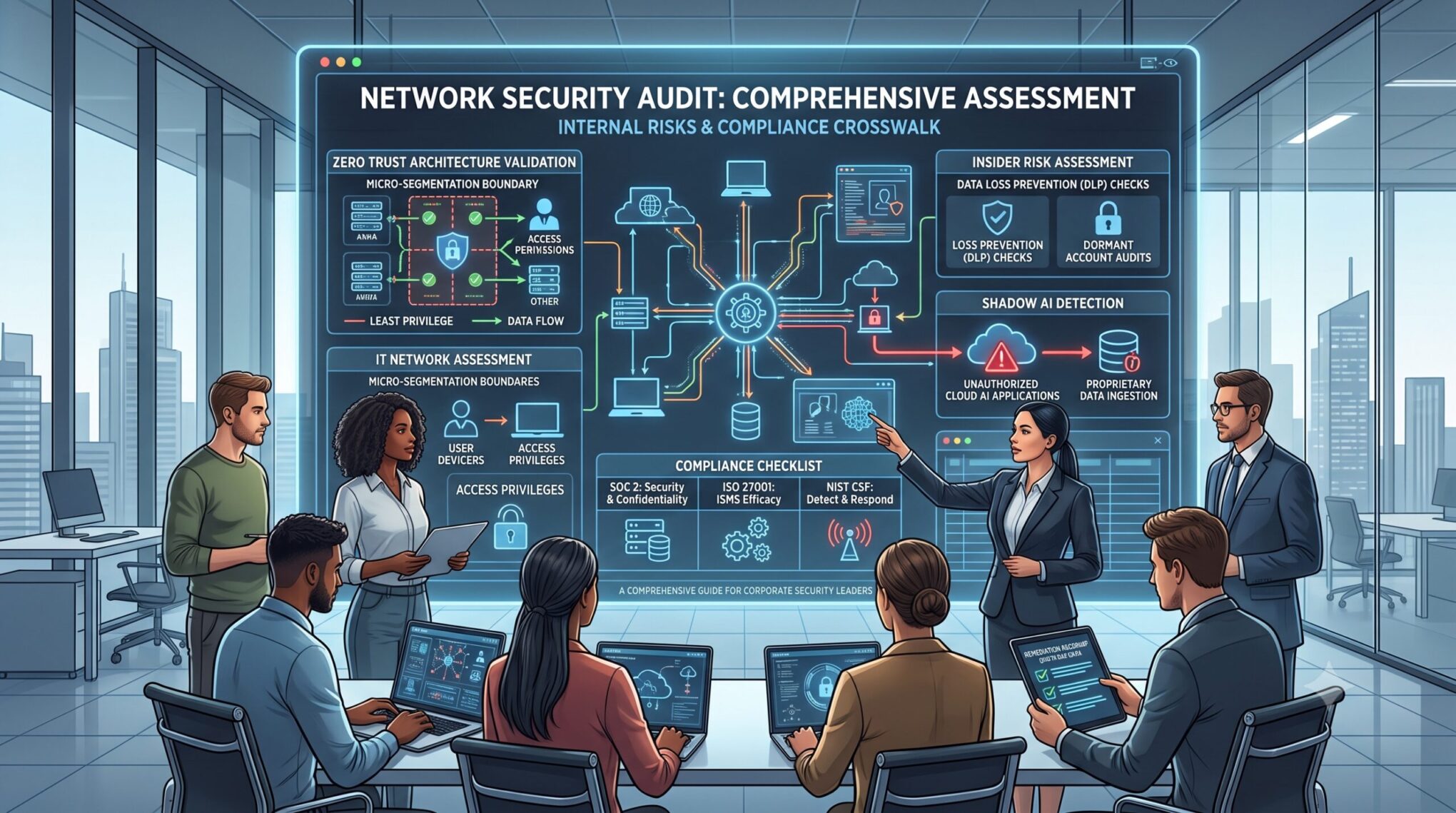
Technology controls must actively enforce your compliance policies. During this phase, the IT support company actively probes your defenses to see how they hold up against both external breaches and internal misuse.
Vulnerability Scanning and Penetration Testing: Automated tools scan your external perimeter, but ethical hackers will also operate from inside your network. They will attempt to escalate privileges, bypass your Endpoint Detection and Response (EDR) solutions, and access restricted segments to demonstrate what a compromised employee account could achieve.
Identity and Access Management (IAM) Review: Access control is the cornerstone of internal security and a primary focus of NIST and SOC 2. Auditors will scrutinize your Active Directory or identity provider for weak credential policies, dormant accounts, and over-privileged users. They will verify if access is strictly governed by the principle of least privilege.
Zero Trust Architecture Validation: Assessors will evaluate your internal network segmentation. If an attacker—or a malicious insider—compromises a workstation in HR, can they seamlessly access financial databases? Effective micro-segmentation is critical to passing rigorous compliance checks.
Technology is only half the equation; human behavior and governance dictate the rest. A thorough audit looks beyond the firewall to examine the policies guiding your workforce and how effectively they map to regulatory standards.
Data Loss Prevention (DLP) and Insider Risk: The audit will review your mechanisms for stopping data exfiltration. Assessors look for blind spots where employees could intentionally or accidentally leak intellectual property via personal cloud storage, USB drives, or unauthorized email forwards.
AI Governance and Shadow IT: As corporate environments rapidly integrate Artificial Intelligence, auditors scrutinize how you manage “Shadow AI”—unsanctioned generative AI tools used by employees that ingest sensitive corporate data. They will assess how proprietary data is cordoned off from external large language models (LLMs).
Vendor Risk Management: Your network is only as secure as the weakest vendor connected to it. Assessors will sample your third-party risk management processes to ensure external partners adhere to your internal security baselines, a strict requirement for both ISO 27001 and SOC 2.
Expect the auditor to categorize their findings based on how they impact your regulatory standing.
| Framework | Core Audit Focus | Internal Security Alignment |
| SOC 2 | Trust Services Criteria (Security, Confidentiality, Privacy). | Validates that employee access to customer data is logged, restricted, and monitored. |
| ISO 27001 | Efficacy of the Information Security Management System (ISMS). | Confirms that HR offboarding, employee training, and internal risk assessments are functioning systematically. |
| NIST CSF | Identify, Protect, Detect, Respond, Recover. | Tests the actual speed at which your internal IT team detects and isolates a simulated insider threat. |
The culmination of the audit is not a dense, unreadable technical dump. You should expect structured, actionable deliverables tailored to different stakeholders.
The Executive and Compliance Report: A high-level summary translating technical risks into business impacts and compliance gaps. This is designed for the C-suite or Board of Directors to justify budget requests and demonstrate due diligence to regulatory bodies.
The Technical Findings: A granular breakdown of every vulnerability and policy failure discovered, complete with steps to reproduce the exploit or mapping to the specific compliance control that failed.
The Remediation Roadmap: A prioritized list of action items. A high-quality IT firm categorizes issues by critical severity, quick wins (like enforcing MFA on a legacy system), and long-term architectural projects (like achieving full Zero Trust maturity).
If you are preparing for an upcoming audit, take these immediate steps to maximize the value of the engagement:
Consolidate Compliance Documentation: Gather your current network diagrams, ISMS documentation, incident response plans, and written security policies. Having these ready accelerates the scoping phase.
Define the Internal Threat Baseline: Draft a list of your “keep-you-up-at-night” scenarios regarding employee access, offboarding gaps, or specific data silos. Direct the auditing firm to focus on these blind spots.
Communicate the Objective: Ensure your internal IT and HR teams understand that the audit is a collaborative effort to fortify the business and achieve compliance, not an investigation into their individual performance.
Regulatory compliance and internal security are not static destinations; they require continuous adaptation. Do not wait for a failed compliance audit or an insider data breach to reveal the blind spots in your architecture. Partner with a trusted Managed IT services provider today to schedule a comprehensive security assessment. By proactively testing your defenses, refining your internal access controls, and aligning your infrastructure with SOC 2, ISO 27001, and NIST standards, you transform theoretical vulnerabilities into verifiable corporate strengths.


