-
Connect With Your Ottawa IT Service Company at (613) 828-1384

Connect With Your Ottawa IT Service Company at (613) 828-1384


In the early days of corporate networking, security was often compared to a castle: once you cleared the drawbridge and passed the guards at the gate, you were free to roam the halls. But today, that “castle” has been replaced by a sprawling, borderless ecosystem of remote offices, cloud applications, and personal devices.
The old security mantra of “trust, but verify” is no longer enough. In an era where identity is the new perimeter, we must shift our mindset to a more resilient framework: Zero Trust.
Zero Trust isn’t just a buzzword, a single piece of software, or an initiative that belongs solely to the IT department; it is a fundamental shift in philosophy that must be embraced across your entire organization.
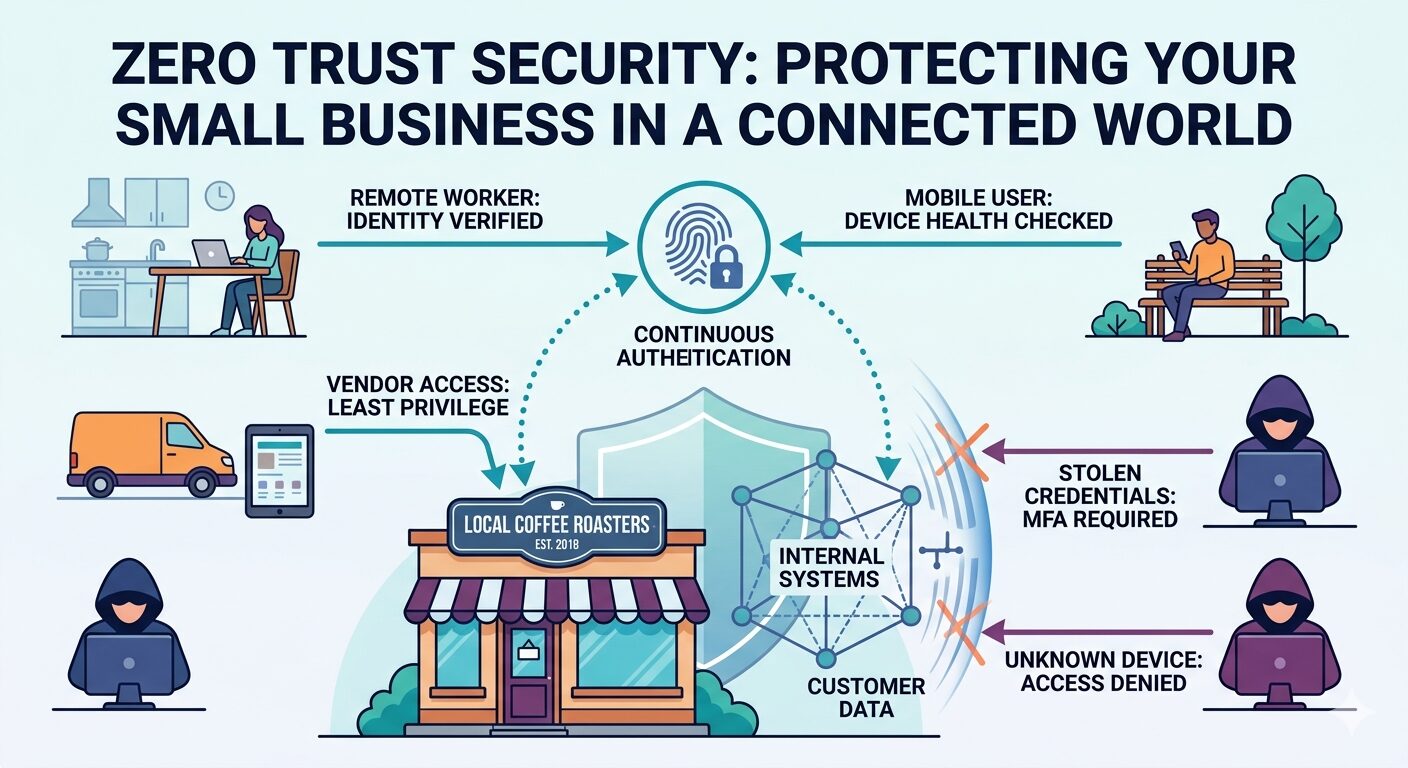
At its core, Zero Trust operates on a simple, yet powerful principle: never trust, always verify. Whether a connection request comes from inside the corporate headquarters or a coffee shop halfway across the world, every user, device, and application must be continuously authenticated and authorized.
In the past, organizations relied heavily on VPNs and firewalls. If an attacker managed to steal an employee’s credentials, they were granted the keys to the kingdom, allowing them to move laterally across the network undetected. Zero Trust assumes that a breach is inevitable—or has already occurred—and builds defenses around individual assets rather than the network perimeter.
A common misconception is that Zero Trust is strictly an IT or cybersecurity project. In reality, implementing Zero Trust requires buy-in, collaboration, and adaptation from every single department:
Implementing this framework across your business involves several crucial steps:
Transitioning to a Zero Trust architecture provides benefits far beyond just stopping hackers. It enables secure remote work by giving employees frictionless access to cloud apps without relying on clunky, slow legacy VPNs. It simplifies compliance with strict data privacy regulations by providing granular visibility into exactly who is accessing what data. Most importantly, if a breach does occur, it drastically reduces the blast radius of the cyberattack.
The digital landscape has changed permanently. The traditional perimeter is dead, and the era of implicit trust is over. It’s time our security strategies evolved. Embarking on the Zero Trust journey today isn’t just about protecting your data; it’s about future-proofing the way your entire business operates.


